Monday, October 10, 2011

Pie Crust

To make a pastry dough for all shaped pies

(Sabina Welserin)
Take flour, the best that you can get, about two handfuls, depending on how large or small you would have the pie. Put it on the table and with a knife stir in two eggs and a little salt. Put water in a small pan and a piece of fat the size of two good eggs, let it all dissolve together and boil. Afterwards pour it on the flour on the table and make a strong dough and work it well, however you feel is right. If it is summer, one must take meat broth instead of water and in the place of the fat the skimmings from the broth. When the dough is kneaded, then make of it a round ball and draw it out well on the sides with the fingers or with a rolling pin, so that in the middle a raised area remains, then let it chill in the cold. Afterwards shape the dough as I have pointed out to you. Also reserve dough for the cover and roll it out into a cover and take water and spread it over the top of the cover and the top of the formed pastry shell and join it together well with the fingers. Leave a small hole. And see that it is pressed together well, so that it does not come open. Blow in the small hole which you have left, then the cover will lift itself up. Then quickly press the hole closed. Afterwards put it in the oven. Sprinkle flour in the dish beforehand. Take care that the oven is properly heated, then it will be a pretty pastry. The dough for all shaped pastries is made in this manner. :
http://www.florilegium.org/files/FOOD/Period-Pies-art.html - several recipes for free-standing pie crusts.
http://www.florilegium.org/files/FOOD/pies-msg.html - general discussion of medieval pastry, with several recipes.

In its most basic definition, pie crust is a simple mix of flour and water. The addition of fat makes it pastry. In all times and places, the grade of the ingredients depends upon the economic status of the cook. Apicius [1st Century AD] makes reference to a simple recipe for crust (see below). Medieval cooking texts typically instruct the cook to lay his fruit or meat in a "coffin," no recipe provided. Up through Medieval times, pie crust was often used as a cooking receptacle. It was vented with holes and sometimes marked to distinguish the baker/owner. Whether or not the crust was consumed or discarded is debated by food historians. Some hypothesize the crust would have been rendered inedible due to extreme thickness and baking time. Others observe flour, and by association flour-based products, was expensive and would not have been thrown away. Possibly? Pies baked in grand Medieval houses served two classes: the wealthy at the contents and the crust was given to the servants or poor.

"Pies and tarts...In the Middle Ages, these sweet and savory preparations baked in a crust were the specialty of patissiers--who had no other functions...We know that medieval cooks did not always have ovens, and they worked with patissiers, to whom they sometimes brought fillings of their own making for the patissier to place in a crust and bake. This explains why cookbooks intended for professional chefs were nearly silent about the ingredients of these pastry wrappings, but spoke only about consistency an thickness, and about the most suitable shapes...Still, medieval cooks might take a chance and cook a simple pie or tart on their own by placing it in a shallow pan, covered with a lid and surrounded by live embers, whose progress they had to monitor very closely...In effect, the pastry because an oven, ensuring moderate heat thanks to its insulating properties...So could it be that these pastry coverings were not necessarily eaten once they had done their job of containing and protecting the fillings?"

---The Medieval Kitchen: Recipes from France and Italy, Odile Redon et al, [University of Chicago Press:Chicago] 1998 (p. 133-4)

Pie crusts are listed with their receipe respectively below in Apple Pear Pies.

Various Authors. “Stefan’s Florilegium flour-msg”
<
http://www.florilegium.org/files/FOOD-BREADS/flour-msg.html>

Apple Pear Fruit Pies

Fruit pies of the 15th and 16th century. Included is the pastry crust recipe for each of the pies.

Medieval Fruit Pies – Apple, Pear

Facts and interesting information about Medieval Food and meals,
specifically, Medieval Fruit
Medieval Fruit
The wealthy nobles of the Middle Ages ate little fresh fruit and unprepared food of this variety and was viewed with some suspicion. Fruit was usually served in pies or was preserved in honey and fresh fruit was traditionally  eaten by the poor. Little was known on nutrition and the Medieval diet of the rich Nobles lacked Vitamin C and fiber which led to an assortment of health problems from bad teeth, to skin diseases, scurvy and rickets!


Medieval Fruit availability
Western Europe was originally very poor in fruits, and was improved by foreign importations, mostly from Asia by the Romans. The apricot came from Armenia, the pistachio-nuts and plums from Syria, the peach from Persia, the cherry from Cerasus, the lemon from Media, the pomegranate, the quince from Cydon in Crete; the olive, fig, pear, and apple, from Greece. The quince, generally cultivated in Medieval Times, was looked upon as the most useful of fruits. Not only did quince form the basis of the farmers' dried preserves to make a sort of marmalade, but it also served for seasoning meat. Several sorts of cherries were known, but did not prevent the small wild or wood cherry from being appreciated at the tables of the peasants.

Wild and Exotic Medieval Fruit
The Portuguese claimed the honor of having introduced oranges from China. Raspberries were still completely wild and wood strawberries have been introduced into gardens in Medieval times. Apples was the only cultivated fruit, but their are other varieties that grew wild. Some wild fruits like pears, quinces, and peaches were served on a few medieval tables. Wild strawberries, raspberries, and red currants could be found in the woods. It was only Nobility that could afford exotic fruits such as dates. It is about the same date melons begin to appear and were watered them with honeyed or sweetened water.
Medieval Fruit
The following fruits were available during the Medieval era, even though many were looked upon with sheer distain, especially by the Upper Classes. Below is a list of some of the fruit available during Medieval times of the Middle Ages:
§         Apples
§         Oranges
§         Lemons
§         Apricot
§         Quince
§         Peaches
§         Cherries
§         Strawberries
§         Raspberries
§         Red currants
§         Melons
§         Pomegranate


PIES

Pies; the filling and baking of sweet fruits, nuts, and cheese or savory  which are of meat, fish, eggs, cheese as primary ingredients and spices in casings composed of flour, fat, and water is an ancient practice. The basic concept of pies and tart changed little throughout the ages. Cooking methods baked or fried in ancient hearths, portable colonial/pioneer Dutch ovens, modern ovens, flat bread, flour/fat/water crusts, puff paste, milles feuilles, and cultural preference: pita, pizza, quiche, shepherd's, lemon meringue, classic apple, chocolate pudding, alll figure prominently into the complicated history of this particular genre of food.
The first pies were very simple and generally of the savory kind. Flaky pastry fruit-filled turnovers appeared later in the early 19th century. Some pie-type foods are made for individual comsumption of which these portable pies... pasties, turnovers, empanadas, pierogi, calzones...were enjoyed by working classes and sold by street vendors. Pie variations; cobblers, slumps, grunts, etc. are endless!
The Oxford English Dictionary traces the first use of the word "pie" as it relates to food to 1303, noting the word was well-known and popular by 1362.
"Pie...a word whose meaning has evolved in the course of many centuries and which varies to some extent according to the country or even to region....The derivation of the word may be from magpie, shortened to pie. The explanation offered in favour or this is that the magpie collects a variety of things, and that it was an essential feature of early pies that they contained a variety of ingredients....Early pies were large; but one can now apply the name to something small, as the small pork pies or mutton pies...Early pies had pastry tops, but modern pies may have a topping of something else...or even be topless. If the basic concept of a pie is taken to mean a mixture of ingredients encased and cooked in pastry, then proto-pies were made in the classical world and pies certainly figured in early Arab cookery."
---The Oxford Companion to Food, Alan Davidson [Oxford University Press:Oxford] (p. 602-3)

A fourteenth century apple pie


A. Redaction

From The Forme of Cury: XXVII For to make Tartys in Applis.

Tak gode Applys and gode Spycis and Figys and reysons and Perys and wan they are wel ybrayed colourd with Safron wel and do yt in a cofyn and yt forth to bake wel. 


Modern Redaction:


Filling:
  • 8 large Golden Delicious apples, if available Granny Smith apples peeled, cored and sliced
  • 4 Bartlet pears peeled, cored and sliced
  • ½ cup of raisins
  • ½ cup of figs, sliced
  • 2 tsp cinnamon,
  • 1 tsp nutmeg
  • 1 tsp ginger
  • ¼ tsp cloves   
  • a pinch of saffron
Pie Shell (modified slightly from “Raising a Coffin”):
  • 2 cups of wheat flour
  • 1 tsp salt
  • 1 cup of butter
  • ½ cup of milk
  • egg yolks for glazing
Rub a tablespoon of the butter into the flour and salt with your fingertips. Take the remaining butter, and add it to the liquid. Heat the liquid over med. heat until it just breaks a boil, and the butter is melted. Make a well in the flour, dump in the liquid and melted fat, and stir quickly with a wooden spoon to combine. Cover with a cloth to keep it warm, and let the dough rest for 10 minutes or so in a warm place.

Pinch off two thirds of the very warm dough. Reserve the remaining third for the lid, in a bowl with a cloth covering it. The amount that was made was used on and inch base, with sides approx. 2 to 3 inches high. Pat the dough into a circle. With knuckles, thumbs, palms, and any other means possible, mold the dough into a bowl shape or cylinder. Splay out the top edges slightly.

Roll the remaining dough into a circle. Flatten out into a ten inch circle. Cut a one-inch circle in the center. If you have any excess dough, use it to decorate the lid or sides with rosettes, leaves, vines, etc. Score the bottoms of these with a fork, and moisten, then attach to a scored section of the lid. When the pie has been filled, moisten the edges of the base. Put the lid on top. Pinch the edges together. Using a small knife or kitchen shears, cut small, inch deep cuts into the edges, making an even number, all around the edge. Fold every other "notch" down, to make a crenellated edge. Pinch the crenellations to ensure they stay down.

Mix all of the pie filing ingredients together. Pour into the pie shell and cover with the pie lid. Bake at 350º F for one hour. After one hour, glaze the pie shell with the egg yolk for a lovely golden brown color. Return to the oven for another twenty minutes. 


A sixteenth century apple pie

A. Redaction

From A Propre new booke of Cokery: To make pies of grene apples.

Take your apples and pare them cleane and core theim as ye will a Quince then make your coffyne after this maner take a little faire water and halfe a disshe of butter and a little safron and set all this vpon a chafyngdisshe till it be hote  then temper your flower with this vpon a chafyngdissh till it be hote then temper your floure with this said licour and the white of two egges and also make your coffyn and ceason your apples with Sinamon  ginger and suger inough. Then put them into your coffyn and laie halfe a disshe of butter aboue them and close your coffyn and so bake them. 

Modern Redaction:

Filling:
  • 10 large Golden Delicious, peeled, cored and sliced
  • 1 cup of sugar
  • 1 tsp cinnamon
  • 1 tsp ginger
  • ½ cup of butter, cut into pieces, room temperature
Pie Crust:
  • 2 cups of all-purpose flour – (or other types of flour)
Have made using all purpose flour and buckwheat flour
  • pinch of saffron (you may choose to leave out – as this is a coloring agent)
  • 1 cup of water
  • ½ cup of butter
  • 2 egg whites
Mix the butter, the saffron and the water together and simmer over a low heat. Do not boil. Arrange the flour in a bowl so there is a well. Pour the butter mixture into the well and begin working the dough. Add two egg whites to the dough. Knead in a little extra flour if needed but do not over-knead. Roll out into two shells. 

Mix all of the pie ingredients together, except the butter, and pour into the pie shell. Carefully place the butter on top of the apple mixture. Cover with the lid. Bake at 375º F for one hour.


Bibliography

Burke, Ray. “The Bee, The Reed, The Root: The History of Sugar”, 1997.
<
http://www2.gasou.edu/gsufl/sugar/sugar-b.htm>

    
Flandrin, Jean. “Seasoning, Cooking and Dietetics in the Late Middle Ages” from Food, a Culinary History, New York, 1999.
 
The Forme of Curye, facsimile. Friedman, David and Elizabeth Cook.
<
http://www.pbm.com/~lindahl/foc/>

“Concerning Trees and Their Fruit”, 1988.
<
http://www.pbm.com/~lindahl/cariadoc/trees.html>
    
Gerard, John. Herball or generall historie of plants, 1594.
<
http://rainweaver.com/Herbal_Guild/mandrake.html>

Herr-Gelatt, Lis, writing as Dame Aoife Finn. "Raising a Coffin or the Fine Art of Making Period Pies."
<
http://www.florilegium.org/files/FOOD/Period-Pies-art.html>

Hieatt, Constance and Butler, Sharon. editors and translators. Curye on Inglysch. England, 1985.
 
Matterer, James. “To make a Char de Crabb”, 1998.
<
http://www.godecookery.com/goderec/grec77.html>

McDaniel, Amanda “Galen.” University of Virginia; 2003.
<
http://hsc.virginia.edu/hs-library/historical/antiqua/galen.htm>

A Propre new booke of Cokery, facsimile.  James L. Matterer, trans.
<
http://www.godecookery.com/trscript/trscript.html>
 
Redon, Odile, Francoise Sabban and Silvano Serventi. The Medieval Kitchen. Trans. Edward Schneider. Chicago, 1998.

Rumpolt, Marxen. Ein New Kochbuch, Germany, 1581. Grasse, M, translator.
<
http://clem.mscd.edu/~grasse/GK_ASappletart.htm>

Scully, D. Eleanor. Early French Cookery. Ann Arbor, 1995.

Scully, Terence. The Art of Cookery in the Middle Ages. Woodbridge, England. 1995.

Scully, Terence, trans. Cuoco Napoletano: The Neapolitan Recipe Collection. Ann Arbor, 2002.

Washington Apple Education Foundation, “Golden Delicious”
<
http://www.bestapples.com/varieties/golden.html>
  
Various Authors. “Stefan’s Florilegium flour-msg”
<
http://www.florilegium.org/files/FOOD-BREADS/flour-msg.html>
Valoise Armstrong (tr) Der Kochbuch der Sabina Welserin (1553). http://www.daviddfriedman.com/Medieval/Cookbooks/Sabrina_Welserin.html
Luigi Ballerini (ed), Jeremy Parzen (tr) and Stefania Barzini (2005) The Eminent Maestro Martino of Como: The Art of Cooking: The First Modern Cookery Book. California Studies in Food and Culture, 14. Edited and with an Introduction by Luigi Ballerini, Translated and Annotated by Jeremy Parzen, and with Fifty Modernized Recipes by Stefania Barzini. http://www.ucpress.edu/books/pages/9423.html
Catherine Francis Frere, ed. (1913) A Proper Newe Booke of Cokerye (of the sixteenth century). In A collection of Medieval and Renaissance Cookbooks, 1991, Duke Cariadoc of the Bow.
Constance B. Hieatt and Sharon Butler, eds (1985). Curye on Inglysch: English culinary manuscripts of the fourteenth century (including the Form of Cury). London: Oxford UP.
Gervase Markham (1683) The English Housewife. Transcribed by Kirrily Robert, http://infotrope.net.sca/texts/english-housewife
Cindy Renfrow, 1991, Take a Thousand Eggs or More: A Collection of 15th Century Recipes, Volume 1, published privately
Terence Scully (1995) The Art of Cookery in the Middle Ages. Woodbridge: Boydell.
Comments in making the 14th century apple pie.

In the making of this pie, I Christiana have included recipes from the gode cookery for the filling and used the recipe from Propre New Book of Cokery – Pie crust from England 1545. It is also listed in this blog. Account of no oven for the campout, the pie was made in a residencial house kitchen, and transported ready made.

In attempting the first try at this recipe it should be noted not to try and reheat to serve hot, as this has a tendency to harden the pastry of the pie. The first attempt was made with, all purpose flour, and the use of butter and this may have in fact when reheated on uneven heat (camp stove) may have been the cause to make the crust hard. The second pie, was not reheated in this method, but allow to warm up to outdoor temperature which was 30 degrees C. and thus the crust was tender and in making the crust tender did take up some moisture from the pie filling.

Saturday, July 30, 2011

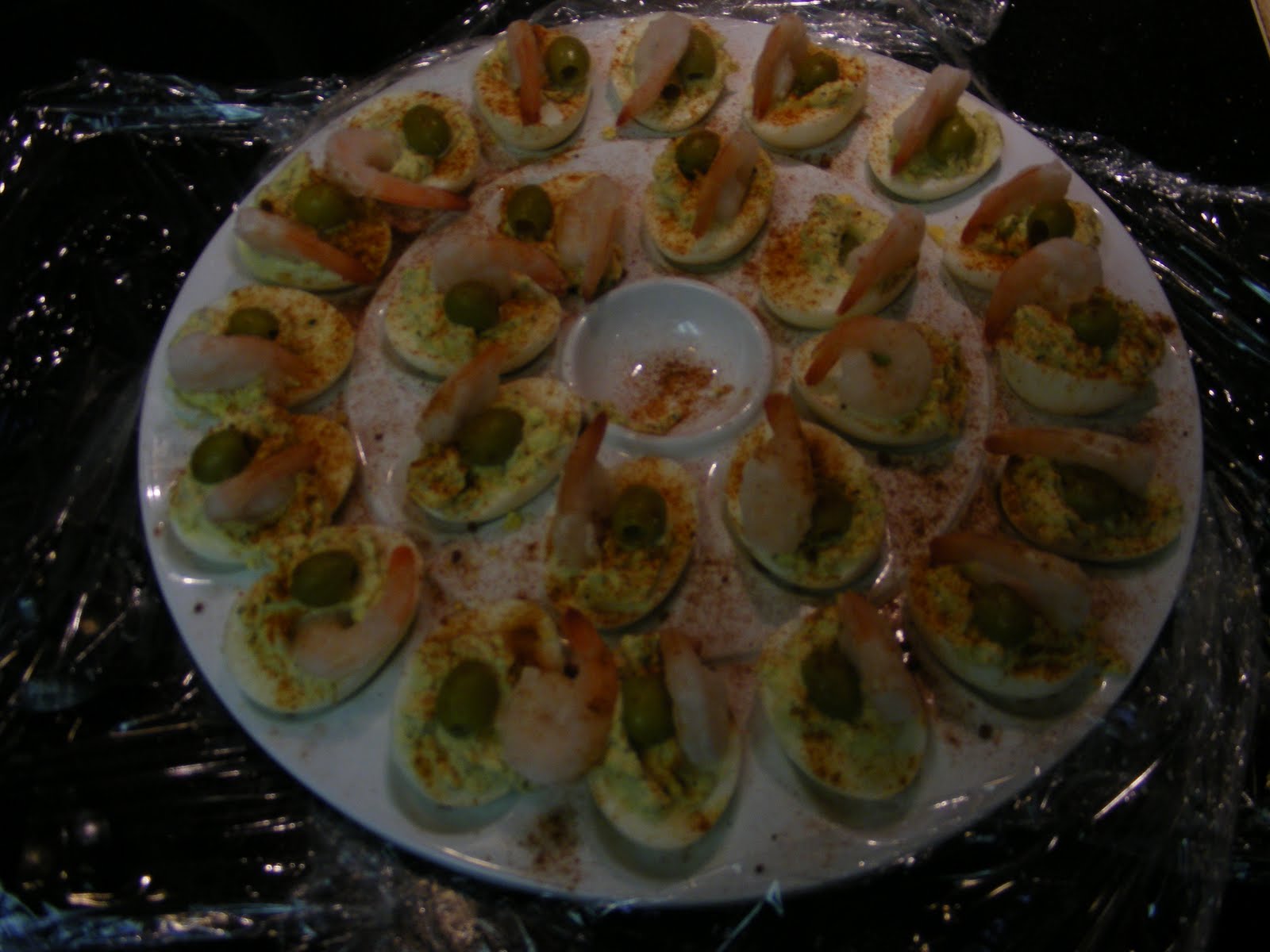
Farce Eggs (Deviled eggs)

Dish  of Farce Eggs prepare by Mistress Christiana Elizabeth Constable a member
of the Duchy of Connacht - Adrian Empire

To Farce Eggs
Take 8 eggs and boile them hard. Peel off shells, cut every egg in the middle: them take out yoks. Make your farcing stuff as you do, for fles saving only you must put butter into it instead of suet and that a little so done, fill your eggs where yolks were and them bring them and swwthe them a lttle. And so serve them to the table. (The Good Housewife jewel  Thomas Dawson, withan introduction by Maggie Black {London 1596} p 86.

The making of Stuffed eggs
Take as many eggs as you like, and boil them whole in hot water, put them in cold water and split them in half with a thread, Take the yolks aside and pound cilantro, and put in onion juice, pepper and coriander, and beat with murri, oil and salt and kneal the yolks with this until it forms a dough. Then stuff the whites with this and fasten it together, insert a small stick into each egg and sprinkle them with pepper. God willing (Anonymous Andalusiein Cookbook of 13th century - translated by Charles Perry)

This recipt is close to the one I Christiana learned at an arts and science session at the 2010 Tir Righ Arts and Sciences October - Kamloops. This is the closest version to that of my lost notes. Please note that some items were not available and substitutes were made.

Translation and substitutes
List of ingredients and methods
A doz eggs hard boils, with the yolks removed and placed in mixing bowls
Grind up the cilantro and onions - Cilantro were substituted with spinach.
Add olive oil and red wine vinegar (optional) and mixed all together with a pinch of salt and pepper.
Make into a dough and at to egg whites, and serve.

I Christiana also took a session on Roman Cookery at the same event, and for those that wish to try this recipe remove the cilantro and add an oil fish like anchovy paste. It will have a tendency to taste salty so you may wish to not add salt to this recipe.

Deviled eggs have their roots in ancient Rome recipes with the first published recipes for stuffed boiled eggs there from Medieval Europe. It should be noted that the term deviled name was coined in 18th Century England.

Where did the English word egg originate from? Eggs track it name back to prehistoric Indo European source related to words birds. The old English term was oeg, which survived in Middle English, as eq (plural eyren) but in the 14th century the related egg was borrowed from Old Norse (Oxford University Press Oxrd) 2002 pg 117.

Preparation of Eggs: As most do not have the luxury of collection of fresh eggs, most will have to acquire the eggs from the local grocery store. The eggs for this process should not be farm flesh, as if they are quite flesh, and when coming to removing the shell, the shell will have a tendency to stick while peeling. Since I use to raise chickens, the flesh eggs would not have much of an air sack and would sink to the bottom of the pan. Store bought eggs will have a tendency to point upward when in water. If they float totally the egg is very old, and should not be used.

To center the yolks before cooking, one may lay the eggs on there side. Eggs from the store are stored upright, and the yolk will tend to settle to the bottom on the egg. In placing them on their sides this helps in centering the yolk which will take about 12 hours.

Cooking the eggs: Bring eggs up to room temperature. You can speed this process up by running warm water over the egg, until reaching room temperature. The temperature of the egg at start of cooking will affect the cooking time (eggs at room temperature will require approx 1 minute less cooking time than eggs taken directly from the refrigerator).

Place eggs in a single layer in a pan with enough cold water cover eggs completely covered.

Bring eggs to a boil, remove from heat, cover tightly with a lid, and allow to remain in water for 15 to 20 minutes. If eggs are boiled, or cooked to long, the protein toughens and or will become rubbery and a greenish or purplish ring forms around the yolk.

Place hot eggs under running cold water to cool quickly which is also known as "codding." This can also be done also by placing cold water and ice in a pan to speed up the process. This allow steam to form under the shell, and will help in easing the egg white from sticking to the shell and will help assist you in the egg shell peeling process easier.

Storage: If not going to the next step immediately you will have to refrigerate the hard boil eggs within hours. Hard cooked eggs in the shell will keep for a week. Please note do not peel the eggs of their shells till ready to process in the next steps.

Steps:
1) Let eggs cool than peel
2) Using sharp knife cut eggs lengthwise in half
3) Remove egg yolk and place yolk in mixing bowl
4) Using fork mash egg yolks together
5) Add ingredients to mashed egg yolks
6) fill eggs whites with yolk mixture to have mixture heaping
7) Arrange filled white on plate
8) garnish with desired toppings

NOTE: Serve well chilled:  Stuffed eggs may be made more more than one day in advance and MUST be kept covered and refrigerated. 3 C is the idea temperature for storage. Note: As temperature increases in storing and or serving, undesirable bacteria will form within hours, therefore it is important to keep chilled until served.

As I Christiana have many variations of farce eggs, I have included the recipe of the dish shown in the photo above. You may wish to leave the mayonnaise out, but you will have to apply a binder for the egg dough, which can be made of red wine vinegar, and olive oil. Therefore where I call for mayonnaise substitute this in its place

12 eggs hard boil with yolks removed                            1 1/2 tablespoons of mayonnaise
tsp of onion juice                                                          salt and pepper to taste
pinch of dill weed ground

Topping
pinch of Spanish Paprika
shrimp or olives - black or green
tooth picks.

Optional - Substitute for mayonnaise
1 1/2 Tablespoons olive oil
1/2 Tablespoon red wine vinegar

Serves 12 assuming two halves for each. Note it is not everyone that wishes to eat farce eggs, but it does work as an advertiser before a meal.


Thursday, June 16, 2011

Glazed Carrots

Honey Glazed Carrots

A bit of history: The 16 century Netherlands seen the development of the orange carrots that we have today. Prior to the 16th center the carrot range in colors from red, purple, yellow and white. The carrot originated from regions around Pakistan and Afghanistan and it still to be the center for carrot diversity. Carrots arrived in Roman Times in the eastern Mediterranean and was introduced in Italy, and Greece before moving to the Middle East. In the 14th century carrots are mentioned in the "Le Menagier Paris" as been red roots sold at markets. It should be noted that some of these Medieval varieties are still possible to attain which have names as Purple Dragon (Dragon), Comic Purple, Labyana, a Slovenian yellow variety and Flemish white. Taste can be similar from old varieties to our common everyday variety however the yellow carrots appear to have a coarser texture making them better for soups and stewing. In Archaeological finds of the 9th and 10 century Viking foodstuffs of vegetables were found in Jorvik (York), Danalaw (England) which were carrots, parsnips, turnips, celery, spinach, brassicus (cabbage)

Carrots are a conical root vegetable, which grows a green leafy stalk and should not be eaten when unripe

source of history


Recipe (1) Honey Glazed Root Vegetables - from Vikingars Gastabud (The Viking Feast)

Ingredients
1 turnip                                                 2 to 3 carrots peeled
1 1/4 heat of white cabbage                  1 leek
butter                                                   honey
salt and pepper

Peel all root vegetable required for recipe and cut into bite size pieces. Boil roots all together in slightly salted water for about 5 minutes and drain. In a fry pan add butter. Once butter is melted add the boiled roots to the pan and suttee till soft. When near soft add cabbage and leeks (cut into pieces before adding) with the roots vegetables. Add honey and stir carefully. Season to taste with salt and pepper. Serve hot: Serves four.

Note: Some people may not care for the flavor of turnips and or cabbage within the glazed carrots so included below are two different versions. which make two tasty dishes

Ingredients
5 carrots                                              1/2 Tsp of salt
20 oz butter                                         3 oz of runny honey
2 tablespoons cider vinegar                  1 teaspoon dried mint
1 Tbsp of cress (cut finely)                   Sliced radishes

(Recipe 3) The version Christiana uses
5 large peeled carrots                           1/2 Tsp of salt
8 oz butter                                           3 oz of runny honey
1/4 Tsp Cinnamon                                dash of nutmeg
1/8 cup raisins                                      Optional - pine nuts, or walnuts, or almonds
salt and pepper

Preparations for recipe version 2 and 3. Peel carrots, cut either into silvers or cross cut no thicker than a 1/4 inch. Boil carrots till just about tender, remove and drain let stand. This should take about 15 minutes. Take butter and met in large fry pan. To melted butter add spices and or vinegar (recipe 2) and stir. Do not burn the butter. Add the drain carrots and other ingredients to mixture, and stir carefully. Add honey, and stir for about 5 minutes. Serve hot - serves six

Sunday, May 22, 2011

Two Roast a Kid (Goat)

Arts  and Sciences project - Stepping Down Coronet - Archduchy of Connacht
Two Roast a Kid
 
This recipe was used in a Archduchy of Connacht - arts and sciences entry for Journayman level. These excerts are from the judges of the Stepping Down Coronet (Adrian) 2011 that took place the weekend before the May (Canadian) long weekend. To acheive journyman level one must hold an average of 25 points among the three judges that are judging the entry. It should be noted that the entry was prepared entirely on the camp site, and serve that evening to the judges. In this conclusion there is a number of factors that one must acheive, and these are Authenticity, (0-6): Functionality, (1-2): Documentation, (0-6) with the aspect of a bonus point of 1; Difficulty and Complexity, (1-6) with a bonus point of 1: and Craftsmaship (1-8) with a bonus of 1,2 or 3. Between the three judges the average point spread was 22.5 points.

Two Roast a Kid

Truss your...Kid procking the head backwards over the shoulder, trying it down; set it and lard it with bacon, and draw it with Time, and a little Lemmon-pill ... And when it is enough serve it up with Vension Sauce.

WILLAIM Rabisha, the whole body of Cookery Dissected

Other Forcing of livers of poultry or kid

Take the Liver raw, and cut it into little bits like dice, and as much interlarded bacon cut in the same form, some sweet herbs, chopped small amongst; a;so some raw yolks of eggs, and some beaten cloves and mace, pepper and salt, a few prumes, and rasins, or no fruit, but grapes or gooseberries, a little grated parmeson, a clove or two of garlick and fill your...Kid.

ROBERT May, The accomplished Cook

Modern Version
1 hindquarter of a young kid, boned - in the book it can be substituted with young pork, but in this case I substituted with leg of lamb.
1/4 pound of chicken livers or kid liver. - note liver can be an over powering favor when cooking, and decided from past expience when cooking with liver on other meat dishes to substitute chicken hearts instead.
1 egg yolk - beaten
1/4 cup Parmedan cheese
1 small bud of garlic minced
2 Tablespoons minced chives - as sometimes chives are not in season, substitute green onion tops
1/8 Teaspoon of mace
1/8 Teaspoon of pepper
1 pinch of cloves

For Basting
2 Tablespoons butter melted
1 Teaspoon salt
1 Teaspoon nutneg

De bone and flatten the meat and remove any tendons. Minced the liver and bacon together, and add all the other ingredients to the minced bacon and liver and mix thoroughly. Spread the dressing over the center of the flatten meat and bring the two sides together overlapping them, then tie the roast crosswise and lengthwise with heavy cotton thread, or butcher cord. Melt the butter for basting and add salt and nutneg. Bast roast with this mixture and roast uncovered at 350 F. for an hour basting every 15 minutes.

In roasting in a open roasting pan it is adviseable to have a bit of water at the bottom of pan to prevent buring of the meat.

Slice the roast, before removing the strings. Arrange slices on a heated serving plater and spoon the pan gravy over the slices.

Source - Dining with Shakespeare (1976) - Madge Lorwin pgs 23-25

Comments from the cook: This is very tastful and filling dish. Please do not over cook lamb as this will not make it juicy, but rather tough and one should use a thermometer and make sure that meat is cooked at 70 C. In serving this dish, preheat a stoneware deep dish, and lay the slices of meat than apply the pan gravy (juices) over the meat. The dish using leg of lamb would serve easly 10 people. As this recipe implies with Dining with Shakespeare, the recipe was used in around the mid 1560s.


Wednesday, April 6, 2011

Boil Duck - Old Elizabethan Recipe

To Boil a Wild Duck

Truss and parboil it, then half rost it, then carve it, and save the Gravie, then take Onions and Parsley sliced, Ginger and Pepper, put the Gravie into a Pipkin, with Currnas, Mace, Barberries, and a qart of Claret Wine, and little salt, put your duck with all the forenamed things into it, and let them boil till it be enoug, then put in butter and sugar, and serve it in upon Sippets.

To Boil a Tame Duck

Take your Duck and truss it, and boil it with water and salt, or rather Mutton broth, when it hath boiled a while, put in some whole spice, and when it is boiled enough take some white wine and butter and good store of Onions boiled tender in several waters, with a little of the Liquor wherein the Duck hath boiled, and a little salt: put your Duck into a dish, and heat these things together and pour over it and serve it: garnish the dish with boiled onions and barberries.

Special note: If your duck arrives frozen please either thaw below 4 degrees C. or in cold water. Do not thaw at room temperature, as bacteria can and will grow thus making the duck useless. In handling of poultry one must be careful, for poultry if not handle correctly can contain some nasty bacteria that can make a person sick. In preparing the duck, thoroughly clean the cavity with cold water, and remove any organs that may be present within the cavity. In preparing the duck, please use a separate plate for draining the water.

In cooking the duck the core temperature should be no less than 70 C. and serving temperature no less than 60 C.

Lets begin:
You will need a pot large enough to cover the whole duck with water. Place duck back down and bring water to boil. Boil duck until meat is tender enough and does not fall off the bones.

Ingredients
3 to 4 lb. duck (domestic will do fine)
dask of ginger, pepper, mace
Parley (fresh preferred but can be done with dry parsley)
1/4 cup currants
1/4 cup barberries - saskatoons can be used as a substitute if one cannot get barberries.
1 cup Merlot wine - substitute for Claret Wine which is a red wine from France used in the 16th century
2 medium cooking onions diced
1 Tbsp sugar - for period cookery use 1 Tbsp honey
1 Tbsp butter - do not substitute
salt to taste
Thickening agent (period - use breadcrumbs - otherwise a Tbsp of flour or cornstarch mixed in cold 1/4 cup cold water)

In preparing Boil duck I used the one for wild duck on a domestic duck and it works quite well. Place the duck on its back and parboil. Once water is boiling it should take about 1/2 hour to parboil - add with a dash of salt. Drain water and let stand in pot with opening down towards bottom of pot to remove any water. This method will remove any excess water from the cavity. At the same time in separate place diced onions and bring to boil till tender, than drain and let stand.

Place duck, back down with butter been applied to vent and neck hole in duck and place in roaster or in a stoneware clay pot with back down. Make sure there is a little water on bottom of rooster to prevent dry out. If you have a roosting rack that can be placed at the bottom of the roaster this will make it easier to remove the duck. Bake at 365 F until meat temperature is at least 70 C. Remove duck from roaster and carve into small bite size pieces and  place into bowl and place aside.

Place juices from the roaster into a pot, add thickener to boiling juice ad wait till thicken. Place boil onions pieces, barberries, and spices within the gravy and simmer for a few minutes. Once gravy is cook add this sauce by pouring over the duck pieces in a serving bowl. Serve hot. Makes 6 servings.

For decorative serving, mix the gravy and the duck pieces together and serve in a traditional stoneware pipen dish, with cover lid. Stoneware will keep the heat, while one dines on this delightful dish. I will mention do not overcook, this dish, as it has a tendency to ruin the flavor.
This dish was used as an entry dish into the cookery selection for Golden Swan person development 2010 by Christiana Elizabeth Constable.

Monday, March 14, 2011

Lion of Pork in Boar's Tail Sauce

This is a very tasty recipe, and below is mention some of the spices that can be left out to improve the taste. The original recipe from MP 146 calls for wild boar, but since wild boar can be hard to obtained, domestic pork can be substituted from local supermarkets. For those that wish to have a close approximating flavor of wild boar you can try marinating the port for a few days in a marinade of white wine, vinegar and oil, and herbs

Ingredients
Begin with a 4 - 6 pound pork roast. Note in my experience, by cutting the amount of the remaining ingredients one can do this on smaller roast, of which I have done roast down to 1 1/2 lbs
whole cloves - This will spice up the meat, and was used in the 1400s to hide the flavor of game meat, and in some cases it might have been used to hide the taste of meat when is begun to age and give off a poor taste. In my experience I have left out the cloves and this has greatly improve the flavor of the meat. You do not want to mask the flavor of the domestic pork.
1/2 tsp each ground ginger, cardamom, pepper and salt
1/4 tsp each cinnamon, ground cloves, nutmeg
1/4 cup wine - In Medieval times it would most likely be clarity wine. A close substitute is Italian Merlot Wine.
1 cup of vinegar
Optional 2 Tbsp of breadcrumbs - this is used as a thickener for the juices -  I substituted corn starch as a thicker thus giving a smoother texture.

If you decide to use whole cloves, push cloves into the loin at 1 - 2 inch intervals. Mix together all ingredients less thicken agents and pour over pork roast. Roast at 365 F and bast from time to time with juices of roast. When the roast is done pour off pan juices, degrease and boil using thicken agents to make sauce.

A note from the cook - I have used this dish many times as a pot luck entry for feast in Medieval anachronism groups. For those that would like to add a bit more flavor to the sauce I have used sliced mushrooms and added these to the sauce.

To serve for artist look. Let roast cool and slice, lay slices in plate. With the sauces pour a thin layer over meat and serve hot.

Comments from cook - You do not need to use pork lion and I Christiana have tried this recipe on lesser cuts of pork meat, like the front shoulder. This is a very tasty dish and was well received both in my family and at pot luck feast events. Enjoy! If you wish to improve on the sauce even more use a few slices of green peppers and cook with the mushrooms in the sauce at the same time. You will need 1/4 cup slice mushrooms and if you wish to use green peppers use 1/8 cup.

Source:
Pleyn Delit - Medieval Cookery for Modern Cooks - second edition (101)